

Scalable Content System with CGI
flexible, high-quality product environments
Client work shown for portfolio purposes only.
A 3D-driven content system designed to reduce production constraints
CONTEXT
Yamaha Golf Car needed a consistent stream of high-quality product imagery across multiple vehicle categories, including fleet, personal, utility, and hospitality. Traditional photography created limits on speed, scale, and flexibility. On-location shoots were expensive, infrequent, and difficult to scale across different environments and use cases. The challenge was finding a way to produce flexible, high-quality assets without relying solely on physical shoots.
EXECUTION
We developed a CGI and 3D workflow built from Yamaha’s CAD files, converting them into fully accurate, production-ready vehicle models. Sensitive data was stripped out, and the models were optimized for rendering across multiple use cases.
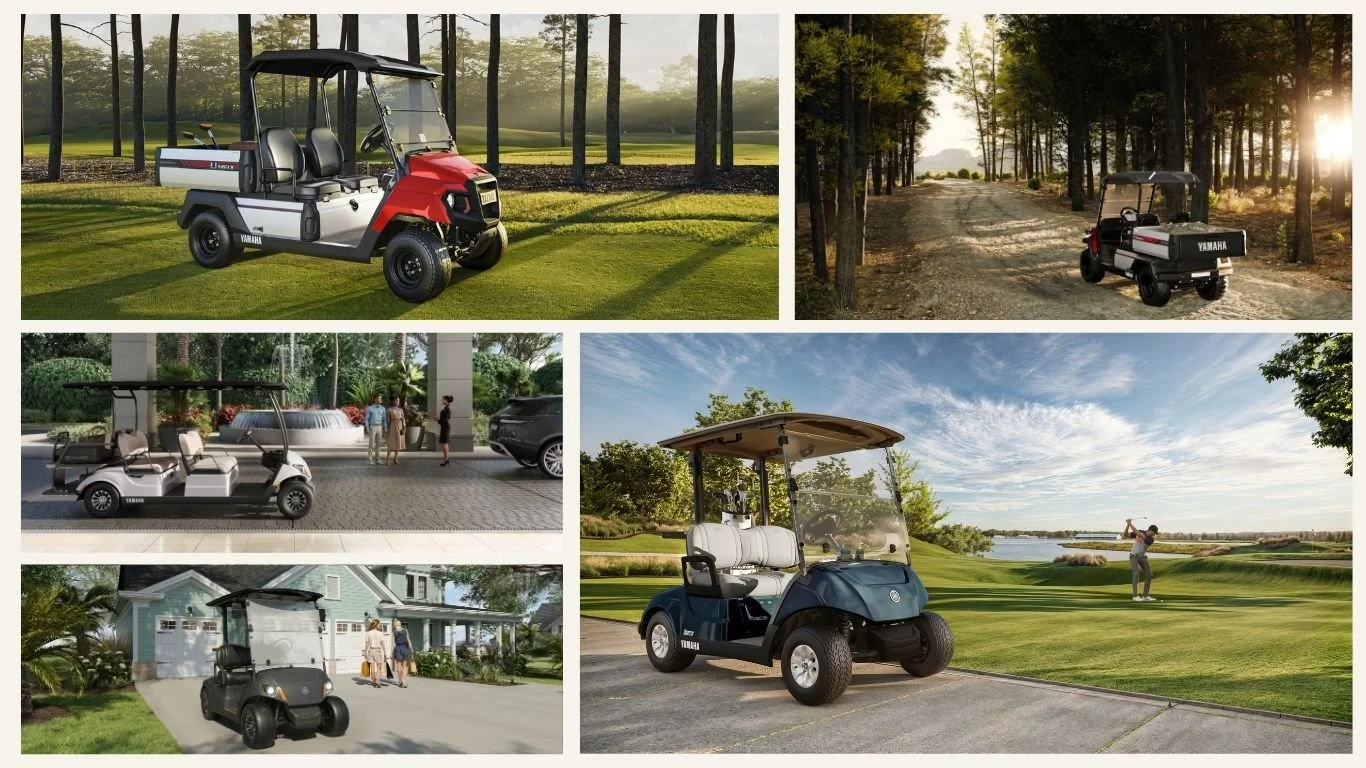
From there, we built a series of custom environments designed to reflect each product category:
Golf course settings for fleet vehicles
Fairways and outdoor terrain for utility
Residential driveways for personal transportation
Hospitality environments for resort use
School settings for multi-passenger configurations
Forest environments for off-road models like the UMAX Rally 2+2
These environments weren’t one-off scenes.
They were designed as reusable systems.
We produced a full library of assets across formats:
High-resolution CGI stills for marketing and print
3D video content within each environment
360-degree vehicle spins for website interaction and customization
Color variations and configuration options rendered digitally
The assets were integrated directly into Yamaha’s website, including interactive 360 views that allowed users to explore vehicles and change colors in real time.
OUTCOME
Yamaha gained a scalable content system that reduced reliance on physical shoots while significantly increasing output and flexibility. Instead of waiting for annual production cycles, the team could generate new assets as needed, adjust lighting and environments, and introduce new vehicle models into existing scenes.
The content supported a wide range of applications:
Website product pages and interactive experiences
Brochures and print materials
Paid media and seasonal campaigns
Dealer marketing and promotional content
This approach allowed Yamaha to move faster, stay consistent across categories, and extend the value of every asset well beyond a single campaign. New vehicles could be introduced into existing environments without rebuilding from scratch, allowing the system to scale alongside the product lineup.
THE RELATIONSHIP
This work reflected a shift from project-based execution to building long-term systems. Yamaha had a partner who could not only produce content but also design the infrastructure behind it, giving their team more control, flexibility, and efficiency over time.
ATTRIBUTION LINE
The following work was led by Tanner Slepp during his tenure at a previous agency. It represents the strategy, production, and creative approach that is the foundation of Slepp House.
Common Questions
When should a company use CGI instead of traditional photography?
1
CGI is ideal when products are still in development, available in multiple configurations, or need to be shown in environments that would be difficult or expensive to photograph. It allows brands to begin marketing earlier while maintaining complete creative control over every image.
Can CGI really look photorealistic?
2
Yes. Modern 3D rendering can accurately recreate materials, lighting, textures, reflections, and environments that are often indistinguishable from traditional photography. When executed well, CGI provides the realism of photography with far greater flexibility.
Is CGI only useful before a product launches?
3
Not at all. Once a 3D model exists, it becomes a long-term marketing asset that can be reused to create new product variations, advertising campaigns, website imagery, trade show graphics, animations, and sales materials without scheduling another photoshoot.
What types of products work best for 3D rendering?
4
CGI is especially valuable for manufacturers with multiple models, color options, accessories, or configurable products. It creates consistent visuals across an entire product lineup while making future updates significantly faster and more cost-effective than repeated photography.
How does Slepp House use CGI within a product launch?
5
We don't see CGI as a replacement for photography—we see it as another strategic tool. Depending on the project, we combine 3D rendering, photography, video, and creative direction to build marketing assets that support product launches, trade shows, websites, dealer materials, advertising campaigns, and ongoing sales efforts.